

What is the DORI Method?
If you’ve ever tried to specify a security camera system and found yourself drowning in megapixels, focal lengths, and field-of-view calculations, you’re not alone. One of the most useful, and most overlooked, frameworks for designing an effective video surveillance system is the DORI method. Understanding DORI can be the difference between a camera system that delivers usable footage and one that looks great on paper but fails when you need it most.
In simple terms, DORI tells you what a camera can do with the footage it captures, not just how many pixels it has. It answers the critical question that every video surveillance system should be asking: “At what distance can this camera perform my required task?”
The Four Levels of DORI
Each level of the DORI method is a progressively higher degree of image detail, and each serves a different operational purpose.
Detection
At the Detection level, a camera can decide whether a person or object is present in the scene. You may be able to tell that something is moving or that a human figure is in the frame, but you won’t be able to make out meaningful details. This is great for perimeter detection or large open area surveillance.
Observation
At the Observation level, you can make out general characteristics of a person, such as their clothing, approximate build, or whether they are carrying an object. This level provides more context but still falls short of reliable identification. This is perfect for general retail surveillance when you want to follow a person’s path through a facility or identify suspicious activity that warrants sending a physical guard to the location.
Recognition
At the Recognition level, there is enough image detail to determine whether a specific person is someone you’ve seen before. If you have prior knowledge of an individual, you can likely make a match at this level.
Identification
At the Identification level, the image quality is sufficient to identify an individual beyond reasonable doubt, definitively. This is the standard typically needed for evidential use, law enforcement investigations, and prosecutions.
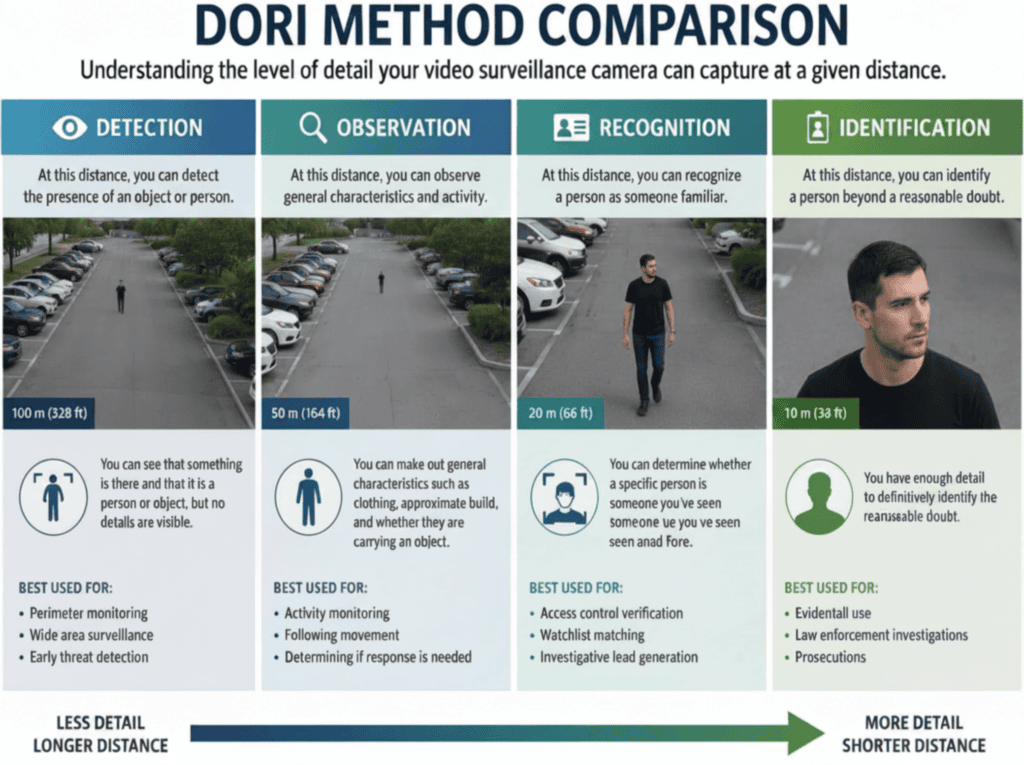
Why Does DORI Matter for Your Camera Specification?
Here is the challenge: a camera’s ability to meet any of these thresholds changes. It will be based on multiple real-world variables, including:
• Camera resolution (megapixels)
• Lens focal length and field of view
• The distance between the camera and the subject
• Lighting conditions
• Camera placement and angle
• Compression settings and frame rate
This is why buying cameras based on megapixel count alone is a recipe for disappointment. A 4K camera pointed at a wide-open parking lot may only deliver Detection-level coverage at 50 meters, while a properly specified mid-range camera with a telephoto lens in the right position could deliver Identification-level coverage at the same distance.
Not sure what level of detail your cameras need?
A professional surveillance assessment can determine exactly where Detection, Recognition, and Identification coverage is required across your facility.
 Final Thoughts
The DORI method exists to bring clarity and consistency to video surveillance design. By understanding what Detection, Observation, Recognition, and Identification mean in practice, we can make far more informed decisions about your security camera system and avoid investing in technology that will not deliver when it matters most. Applying DORI correctly requires practice and expertise. Camera placement, lens choice, lighting design, resolution requirements, and zone mapping all need to work together to achieve compliant, reliable coverage across your entire site.
That’s where we come in. Our team of security consultants specializes in surveillance assessments for organizations across a wide range of industries. We’ll evaluate your site, define your requirements, and deliver a system design with specifications you can trust.
