

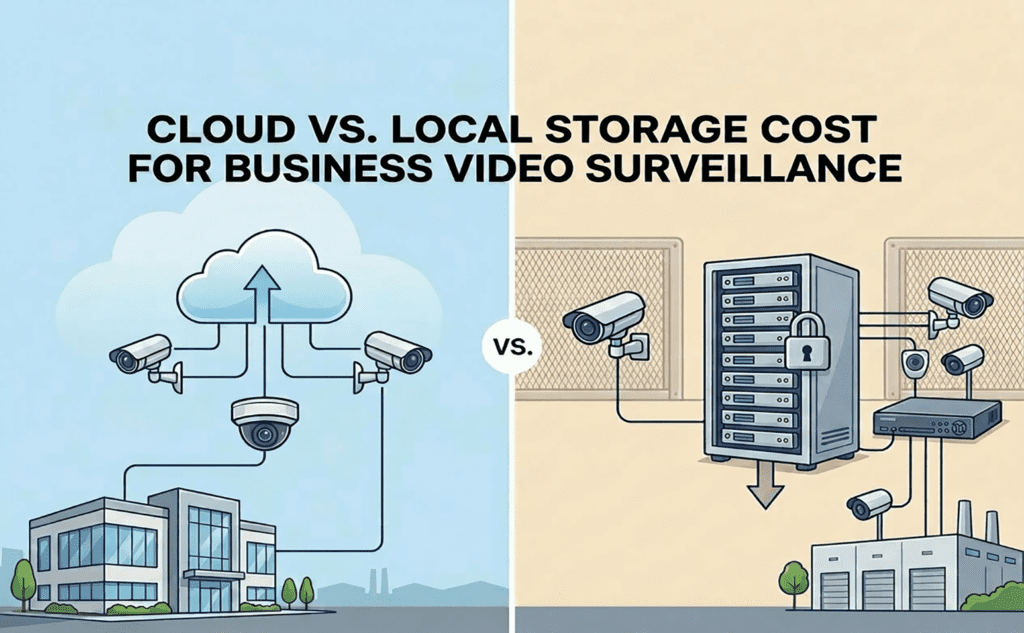
Choosing the right storage system for your business video surveillance system is a critical business decision. While camera features matter, how you store your footage will directly impact your long-term operational budget. Businesses must choose between local on-premises storage and cloud-based systems. Each carries a distinct cost structure that affects your bottom line differently over time. At EPS Security, we urge our customers to consider each option before committing to a solution that best fits the business.
Upfront Costs: Hardware vs. Cloud Onboarding
When comparing cloud vs. local storage costs for business video surveillance, the initial investment scenarios look quite different.
Local storage requires notable upfront costs. You must purchase physical Network Video Recorders (NVRs), commercial-grade hard drives, and the supporting infrastructure. For a small business deploying eight 4K security cameras, hardware alone can easily cost thousands of dollars… before factoring in professional installation fees.
Cloud video storage eliminates or reduces upfront hardware costs. Cameras stream directly to remote servers over the internet, so your primary initial expense is the cameras themselves. This low barrier to entry makes cloud storage attractive for budget-conscious startups. However, initial affordability can be misleading when you look at the full picture.
Ongoing Operational Costs: Subscriptions vs. Maintenance
The financial story shifts dramatically when examining long-term operational expenses.
Local storage is virtually free to operate after the initial setup. Because you own the hardware outright, there are no monthly fees to maintain access to your footage. Ongoing costs are often limited to electricity, occasional system support, and remote mobile access if enabled.
Cloud storage relies entirely on a recurring subscription model. Providers typically charge a monthly fee per camera, scaled by video resolution and your required retention window, commonly 7, 30, or 90 days. Storing high-definition footage across a dozen cameras can quickly reach hundreds of dollars per month. Over a 3-5 year system lifecycle, those subscription fees may exceed the total cost of equivalent local hardware.
Hidden Networking Infrastructure Costs
One often-overlooked factor in the cloud vs. local storage cost comparison is network bandwidth. Continuously streaming high-resolution video to the cloud demands significant upload speeds. Many businesses must upgrade to expensive business-tier fiber-optic internet plans to prevent surveillance traffic from disrupting daily operations, an added cost that rarely appears in initial cloud storage quotes.
Local storage, by contrast, processes and saves data entirely within your internal network (LAN). It requires zero internet bandwidth for recording, shielding you from unexpected internet service provider upgrades.
Long-Term Maintenance and Replacement Cycles
Physical hardware naturally deteriorates. Security hard drives running 24/7 typically need replacement within seven to ten years. On-site server infrastructure may also require dedicated cooling, adding to ongoing utility costs.
Cloud storage removes those hardware maintenance responsibilities entirely. Your security provider should handle all server upgrades, drive replacements, and cybersecurity patches. This offers a level of predictability that simplifies long-term budget planning.
The Bottom Line: Which Storage Option Delivers Better ROI?
The right choice depends on your business’s specific needs:
- Cloud storage is a strong fit if you prioritize low upfront costs, operate a small camera count, and already have robust internet bandwidth.
- Local storage typically delivers a significantly higher return on investment (ROI) for businesses running higher camera counts over several years.
Before upgrading your infrastructure or purchasing a camera system outright, consider requesting a total design quote from EPS Security. Our team can help you evaluate both options based on your camera count, retention requirements, and budget, so you can make the right security and financial decision for your business.
